
How InnerZero Stays Private
A detailed look at how InnerZero protects your privacy. No cloud, no tracking, no telemetry. Here's exactly what happens with your data.
Privacy isn't a feature we added to InnerZero. It's the reason InnerZero exists. Every design decision starts with one question: does this keep the user's data on their machine?
Here's exactly how it works, with no hand-waving.
Everything runs on your PC
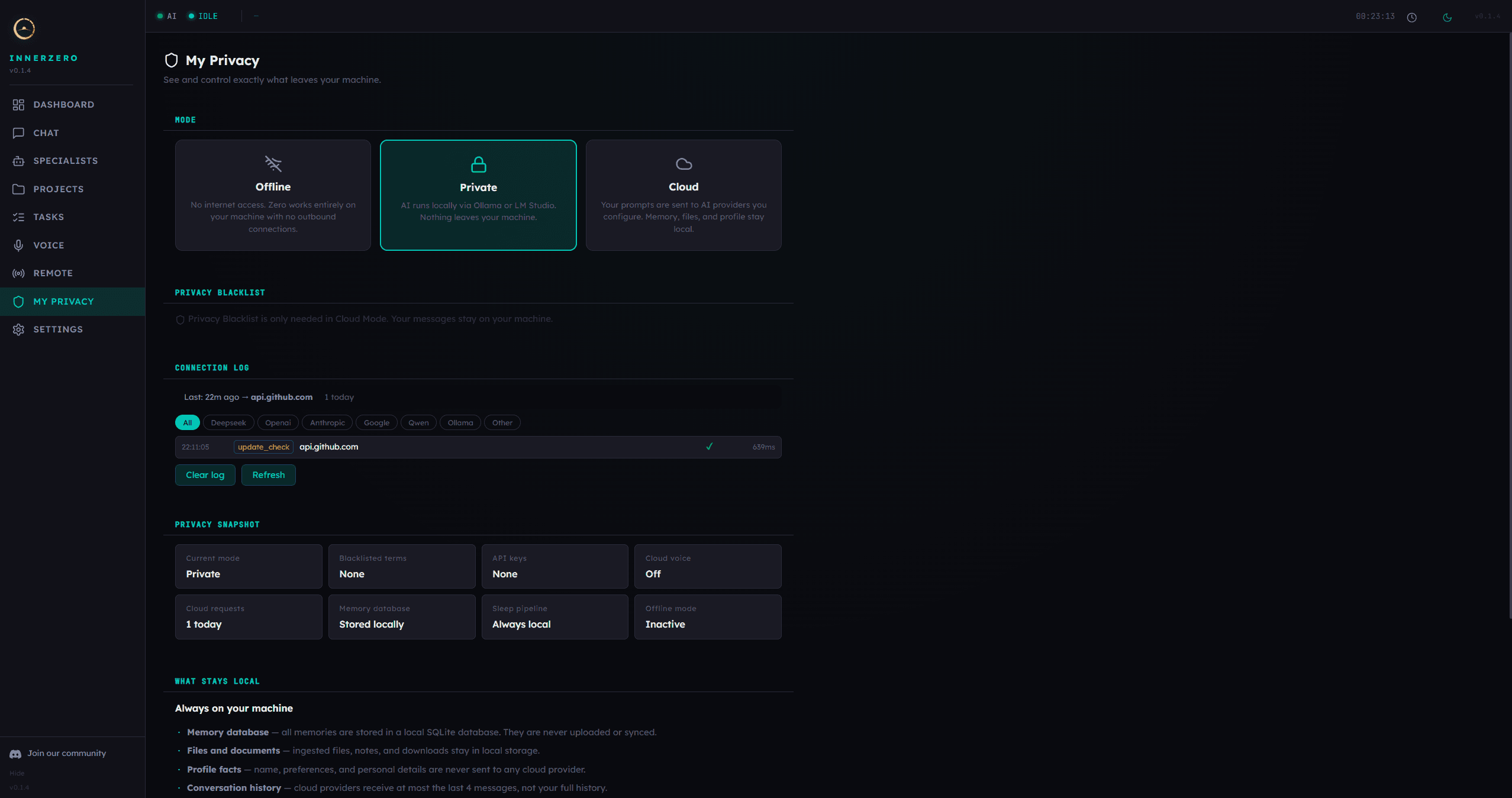
When you send a message to InnerZero, it's processed by an AI model running on your GPU. The model lives on your hard drive. The computation happens on your hardware. Your message never leaves your machine.
This isn't "end-to-end encrypted" cloud processing, which still sends your data to a server. This is genuinely local. Unplug your ethernet cable and it still works. That's the test.
Where is my memory stored?
InnerZero builds a memory of your conversations over time. It learns your name, your preferences, your projects. All of this is stored in a SQLite database file on your hard drive.
There's no server-side backup. No sync to the cloud. No "we store your data securely on our servers." The file sits in your user data folder. You can open it, back it up, or delete it. It's yours.
For more on why local memory matters, read why your AI should remember you.
Do I need an account to use InnerZero?
You can download InnerZero and use it immediately without creating an account, entering an email address, or agreeing to data collection terms. There's no registration flow for the core product.
Accounts exist for optional features like the Business Licence and cloud plans. The local AI assistant doesn't need one.
Does InnerZero send telemetry?
InnerZero doesn't phone home. There are no analytics, no usage tracking, no crash reporting, no beacon calls in the desktop application. When the app runs, it talks to Ollama on your local machine and that's it.
The website (innerzero.com) uses privacy-friendly Vercel Analytics for page views. But the desktop app itself has zero telemetry.
Does voice mode send audio to the cloud?
When you use voice mode, your audio is processed locally using faster-whisper for speech recognition and Kokoro for text-to-speech. No audio recordings are sent to any server. Your voice is transcribed in real-time on your hardware and the raw audio is discarded immediately.
Compare this to Alexa, Siri, or Google Assistant, all of which send your voice to cloud servers for processing and may retain recordings.
How does cloud mode work if I enable it?
InnerZero has an optional cloud mode for people who want access to more capable AI models like Claude, GPT-4, or DeepSeek. This is completely off by default.
When you enable cloud mode, here's exactly what happens:
- Your current message is sent to the cloud AI provider you've chosen.
- Relevant memory context may be included in the prompt (so the AI can give you a useful response).
- Your full memory database is never sent. Your files are never sent. Your profile facts are never sent.
- The response comes back and is stored locally in your memory.
Cloud mode is clearly labelled in the interface. There's a warning when you first enable it. You can turn it off at any time and everything goes back to fully local.
Where are BYO API keys stored?
If you bring your own API keys for cloud providers, those keys are encrypted and stored locally on your device. When a cloud request is made, your key goes directly to the provider. InnerZero doesn't proxy, intercept, log, or read the traffic.
You're responsible for your own API costs and key security. InnerZero is just the interface. Your relationship is directly with the provider.
What cloud AI services do differently
For contrast, here's what happens when you use most cloud AI services:
- Your messages are sent to their servers.
- Your data is processed on their hardware.
- Your conversations may be stored indefinitely.
- Your data may be used to improve their models (unless you opt out, which isn't always easy to find).
- A data breach could expose your private conversations.
- Their privacy policy can change at any time.
InnerZero avoids all of this by keeping the AI on your machine. There's no server to breach because your data isn't on a server.
The bottom line
InnerZero is private because it's local. Not because of encryption, not because of a privacy policy, not because of a promise. It's private because your data physically never leaves your hardware.
That's a different kind of guarantee. One that doesn't depend on trusting a company to keep their word.
Read our full privacy policy for the formal details, or check out what makes local AI different for the bigger picture.
Written by
Louie SummersFounder
Louie Summers is the founder of Summers Solutions Ltd and the sole developer of InnerZero, based in Birmingham, UK. Every post here is written by the person who builds the product.
Related Posts
Who Builds InnerZero? The Company Behind Your Private AI
InnerZero is built by Summers Solutions, a founder-led UK company in Birmingham. Here is who makes your private AI assistant, and why knowing that matters.
2026-06-22
Why I Built a Coding Agent That Runs Offline
Cloud coding assistants leak your code to someone else's server. Here's why InnerZero's coding agent runs locally, what it does well, and what it can't do.
2026-04-21
Private AI for Lawyers and Legal Work
Private AI for lawyers keeps client files on your machine. How local AI helps with review, summarising, and drafting without sending docs to the cloud.
2026-10-09